

DIGSAU is a 54-person architecture firm based in Philadelphia, Pennsylvania, with 18 years of continuous practice and a client base that has grown steadily since the firm began with just five employees. As the practice grew, its needs evolved, and so did the demands placed on the technology that supports its work. What began as a small studio using a single IT contractor eventually became a midsized firm running heavy design software, managing large project files, and coordinating with external consultants across every active project.
For years, the same small IT provider served DIGSAU well. The relationship was personal, the team knew the firm, and the fit was right for many years. But as the firm grew and its IT needs became more complex, the provider began to feel stretched thin. Operations staff found themselves spending more time resolving recurring issues than working toward a more efficient IT model focused on system-wide improvements.
When DIGSAU decided to test the market and evaluate alternative IT providers, Graffen was one of the firms that responded. What began as a competitive proposal process quickly turned into something more: the beginning of a partnership that has already changed how the firm thinks about its technology.
The Challenge: Leveling up IT practices in a growing firm
DIGSAU’s IT setup had been in place for most of the firm’s history. A single provider with a team of three handled everything, and for years that model worked. As DIGSAU grew from a boutique practice into a 54-person firm, however, the strain began to show.
The core issue was not effort. The previous provider was working hard. But the combination of a small team, an ever-changing IT landscape, and the specialized needs of a midsized architecture firm meant that solutions were increasingly reactive rather than strategic.
Often, the fixes felt like patches, quick ways to mitigate an isolated issue. But when I started noticing broader trends across the firm, it became clear that we needed more holistic solutions. That’s when I began to feel like we needed a larger IT team at our fingertips.
—Kate Julyan, Director of Finance and Operations, DIGSAU
The problems compounded in ways typical of a growing practice:
- Slow file access and general performance issues affecting daily work
- Fixes that resolved symptoms without addressing root causes
- No proactive strategy for the firm’s evolving technology needs
- Leadership time spent following up on tickets, doing independent research, and effectively managing IT as a second job.
The responsibility of overseeing IT had quietly become one of the most demanding parts of a role that spanned finance, operations, and firm-wide coordination.
The Turning Point: A Proposal Process That Set a Different Tone
When DIGSAU began evaluating new providers, Graffen was one of several firms that responded. Some of the other candidates marketed deeper architecture and engineering specialization. What set Graffen apart was not a technical pitch but the way they approached the conversation itself.
The Graffen proposal reflected time spent understanding the firm, its people, and its challenges. Rather than leading with a menu of services, Graffen probed for the root of the issues DIGSAU was facing before offering a recommendation. That thoroughness mattered.
Graffen was also transparent about what they did not know. While some competitors marketed heavy architecture and engineering software experience, Graffen was straightforward about their expertise being broader and their commitment being to uncover the right solutions in partnership with the client. For DIGSAU, that honesty carried more weight than a claimed specialization.
The relationship dimension was equally important. DIGSAU met with both the sales team and Graffen’s president and CEO, Jeff Grimes. Jeff’s story of building his own company incrementally over many years mirrored DIGSAU’s own trajectory. His investment in the local community reinforced a values alignment that made the choice feel right beyond the technical fit.
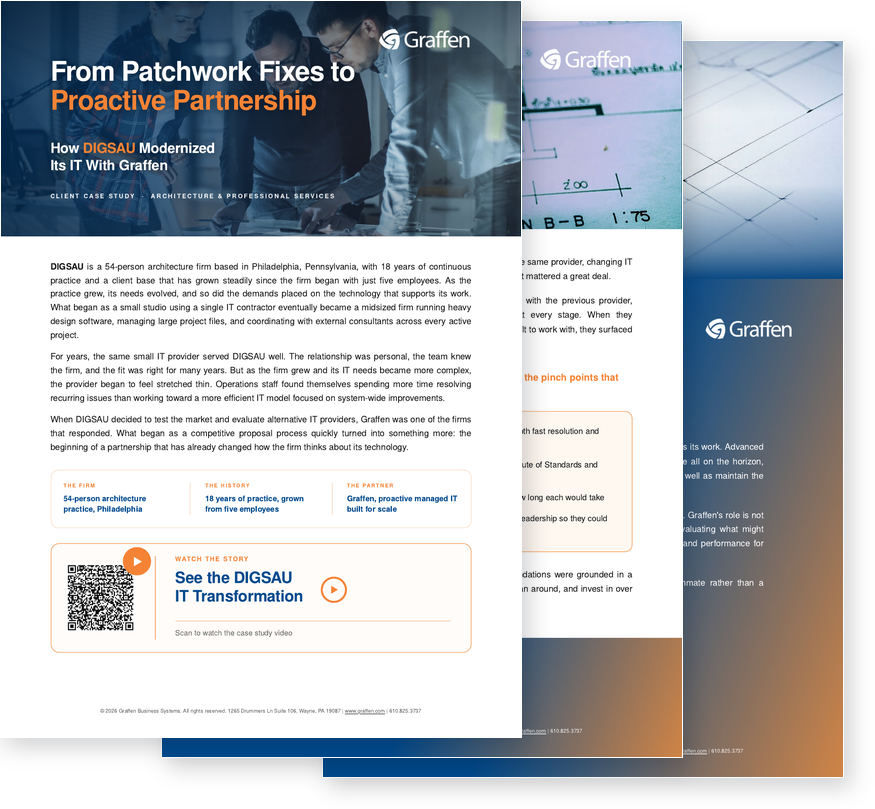
Free Download
The DIGSAU Case Study
Eight designed pages on the vendor transition, the NIST security foundation, and what the partnership delivered in five months.
The Solution: A Structured Transition Backed by a Recognized Framework
The transition itself was a significant moment for DIGSAU. After 18 years with the same provider, changing IT partners was going to affect 55 people across the firm. Getting the transition right mattered a great deal.
Graffen approached the handoff with a clear plan. They coordinated directly with the previous provider, worked through the migration collaboratively, and communicated openly at every stage. When they discovered existing conditions in the environment that were problematic or difficult to work with, they surfaced those findings immediately and explained the implications rather than bury them.
Once the transition was complete, Graffen moved quickly to identify the pinch points that had been affecting the firm and mapped out a plan to address them:
- A proactive support ticketing system that tracks every incident and enables both fast resolution and pattern recognition across the firm
- A structured approach to security and infrastructure built on the National Institute of Standards and Technology (NIST) framework
- Clear articulation of what issues existed, how they would be resolved, and how long each would take
- A cadence of proactive communication that brought recurring issues back to leadership so they could be addressed holistically rather than one ticket at a time.
The NIST-based approach mattered to DIGSAU. It meant Graffen’s recommendations were grounded in a recognized standard rather than opinion, which made them easier to defend, plan around, and invest in over time.
The Results: Time Back, Trust Restored, and a Team That Follows Through
Just five months into the engagement, the changes at DIGSAU are already visible.
The most immediate impact has been on time management. Instead of chasing tickets, researching IT strategy and following up on progress, operations staff are able to focus on their finance and operations responsibilities. The mental load of managing IT as a second job has lifted.
Staff across the firm have noticed the difference as well. Support requests get resolved quickly, communication is easier, and Graffen schedules work with individual users at times that do not disrupt their design workflow. Given that architecture teams often work long hours around project deadlines, that scheduling flexibility is important.
Key outcomes for DIGSAU include:
- A structured, framework-based approach to security and infrastructure decisions
- A proactive ticketing and issue-tracking system that surfaces trends, not just individual incidents
- Direct communication channels with both the day-to-day point of contact and Graffen’s leadership
- A staff experience where support requests are resolved efficiently and courteously.
The broader shift is one of confidence. DIGSAU can work with greater ease and mental capacity to focus on what matters: serving their clients.
Free Download
The DIGSAU Case Study
Eight designed pages on the vendor transition, the NIST security foundation, and what the partnership delivered in five months.
Looking Ahead: A Partner for the Firm’s Next Chapter
DIGSAU’s future growth is less about headcount than about how the firm delivers its work. Advanced design tools, AI-assisted software, and cloud-based collaboration platforms are all on the horizon, and evaluating them thoughtfully requires an IT partner that can look ahead as well as maintain the present.
For DIGSAU, that is one of the most reassuring aspects of the new arrangement. Graffen’s role is not limited to keeping the current environment running. They are also actively evaluating what might come next, what would fit DIGSAU’s model, and what would improve security and performance for the team.
The partnership reflects that shared orientation. Graffen operates as a teammate rather than a vendor, a partner in the firm’s corner who ties its success to DIGSAU’s.
Why This Partnership Works
The DIGSAU engagement is a useful example of what happens when an IT relationship is built on values alignment as much as technical capability.
Graffen brought a proactive process, a structured framework, and a team large enough to provide expertise without being so large that individual clients feel lost. DIGSAU brought leadership that understood the value of doing IT properly and was willing to invest in the transition.
What made the real difference, though, was honesty. Graffen was transparent about what they knew, what they did not, and how they would approach the parts they were still learning. That honesty built the trust that has carried the partnership forward.
Ready To Rethink How Your Firm Approaches IT?
If your firm has outgrown a small IT provider, or if you are spending too much of your own time managing an IT relationship instead of running your business, it may be time to consider a different model. Graffen helps growing professional services firms move from reactive support to a proactive, framework-based partnership designed for scale.
Let’s start with a conversation. Visit graffen.com/contact to explore what a stronger IT foundation could look like for your firm.
Frequently Asked Questions
1. Why do growing firms often outgrow small IT providers?
Small providers can serve small firms well, but as headcount grows and technology needs become more sophisticated, a small team can end up stretched too thin to provide proactive support. Fixes become reactive, patterns get missed, and leadership starts spending time on IT oversight that should belong to the provider.
2. Why should an architecture firm work with a managed IT services provider?
Architecture firms depend on high-performance workstations, heavy design software, large project files, and reliable collaboration with consultants and clients. A managed IT partner provides the proactive monitoring, cybersecurity, and infrastructure planning needed to keep design work moving without interruption.
3. What is the NIST framework and why does it matter for IT decisions?
The National Institute of Standards and Technology (NIST) publishes widely adopted frameworks for cybersecurity and IT operations. Using NIST-based practices means recommendations are grounded in a recognized standard rather than opinion, which makes them easier to defend, plan for, and invest in over time.
4. What does a smooth transition from an existing IT provider look like?
A well-run transition includes coordinated handoff with the previous provider, transparent communication about anything discovered in the existing environment, a clear plan for addressing gaps, and minimal disruption to staff. The goal is a seamless experience for users, not just a technical migration.
5. How does Graffen tailor its approach for professional services firms?
Graffen designs solutions around how firms work, including their software environment, project cycles, staff schedules, and growth plans. That means scheduling work around design deadlines, communicating in terms leaders can act on, and building infrastructure that supports the firm’s next chapter, not just its current state.
6. How quickly can a firm expect to see results after partnering with Graffen?
Baseline improvements often appear within the first few months. Beyond that, the longer-term gains come from reduced time spent managing IT internally, fewer recurring issues, and a more confident technology posture across the leadership team.
7. How does Graffen support firms as they evaluate new technologies like AI and cloud-based tools?
Graffen monitors emerging technology trends and helps clients evaluate which new tools genuinely fit their business. That includes AI-assisted software, cloud collaboration platforms, and evolving security solutions. The goal is thoughtful adoption grounded in the firm’s real needs, not chasing trends.