

A fast-growing construction and building services company was struggling to keep pace with customer demand. As a business serving residential customers, inbound phone calls were critical. New service requests, repair follow-ups, and urgent scheduling needs all flowed through a centralized call center. Yet the technology supporting that operation had not kept up with the company’s growth.
The organization relied on an aging, on-premise phone system that offered little visibility, limited flexibility, and no meaningful data. Call center managers could not track performance, agents were tied to physical desks, and leadership had no reliable way to understand how calls were being handled day to day.
Recognizing that communication failures directly impacted revenue and customer satisfaction, the company turned to Graffen for expert guidance. Graffen designed and implemented a modern VoIP solution that replaced outdated infrastructure with a flexible, analytics-driven system built to support growth, mobility, and long-term operational control.
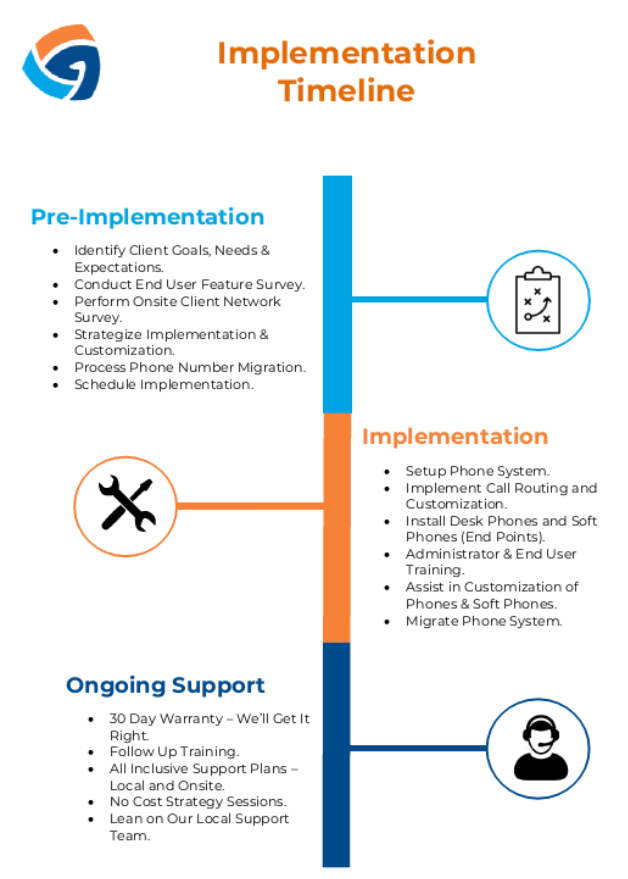
How Graffen Implements VoIP: A Clear Timeline From Planning to Go-Live
Every successful VoIP deployment starts with a predictable process. Graffen guides customers through a structured timeline that reduces uncertainty and prevents disruption. It begins with discovery and technical assessment, then moves into configuration and customization, followed by staged testing using temporary numbers, user training, and a planned go-live. The final step is post-launch optimization, where Graffen reviews performance, fine-tunes call flows, and ensures teams are using the platform effectively.
This approach helps customers understand what happens next at every stage and sets the foundation for a smooth transition.
The Challenge: An Outdated Phone System Limiting Growth
When Graffen first met with the client, the problems were clear. The company was operating on an antiquated NEC phone system that had reached the end of its useful life. Manufacturer support was no longer available, repairs were increasingly difficult, and system limitations were actively preventing the call center from operating efficiently.
The call center handled high volumes of inbound B2C calls related to new projects, service requests, and repairs. These calls could not be missed. However, the existing system provided no meaningful reporting or insight into agent availability, call volume, or customer wait times. Managers were effectively operating blind.
Key challenges included:
- No access to call metrics or performance analytics
- Inability to support remote or hybrid call center agents
- Limited scalability for growing call volumes and staff
- Dependence on unsupported and unreliable hardware
- No visibility into agent behavior, wrap-up time, or call handling patterns
In addition, the system lacked resilience. Leadership understood that if the phone system failed due to weather, flooding, or infrastructure issues, restoring service would be slow and disruptive. Past experiences with copper-based phone outages had already demonstrated how damaging downtime could be.
Without a change, the business risked missed calls, lost revenue, frustrated customers, and stalled growth.
The Stakes: What Failure Would Have Looked Like
Continuing with the existing phone system was not a viable option. The client knew that aging copper infrastructure and legacy phone systems fail at the worst possible times. When outages occur, businesses are often dependent on large telecom providers with slow response times and limited urgency.
In similar situations, businesses had spent days attempting to forward phone numbers or restore basic service. For a call-driven organization, even a few hours of downtime could mean lost customers and damaged reputation. Leadership was determined not to repeat that experience.
The company needed a system that was reliable, portable, and resilient. They also needed a partner who could support the solution long after installation.
The Solution: A Scalable VoIP Platform Designed for Control
Graffen approached the project with a structured, consultative process. Before recommending any solution, they conducted a thorough assessment of the client’s environment, infrastructure, and operational goals. This included evaluating network readiness, call center workflows, staffing models, and future growth plans.
Rather than focusing only on what the client requested, Graffen focused on what the business truly needed.
The resulting VoIP solution delivered:
- Cloud-based calling with built-in redundancy
- Support for in-office, remote, and hybrid agents
- Advanced call queue management
- Real-time and historical reporting
- Voicemail to email and transcription features
- Mobile and desktop applications for agent flexibility
For the call center, the system introduced automatic wrap-up states that prevented agents from manually logging in and out to avoid calls. After each call ended, agents were placed into a defined wrap-up period before becoming available again. This ensured fair call distribution and eliminated productivity gaps that had previously gone unnoticed.
VoIP and AI: Turning Calls Into Insight, Coaching, and Automation
Modern VoIP is no longer only about dial tone and call routing. It is a data-rich system that can improve customer experience and operational efficiency through AI-driven capabilities. In this deployment, the conversation quickly expanded beyond “phones” to what the client could now measure, automate, and improve over time.
As AI capabilities mature, VoIP platforms can support features such as:
- Post-call analysis: AI transcription and summarization, topic detection, and sentiment analysis that help teams evaluate call quality and customer satisfaction.
- Agent assistance: live transcription, voicemail transcription, and AI-enabled wrap-up tools that help agents work more confidently and consistently.
- AI-driven analytics: deeper insights into communication patterns to identify improvement opportunities and optimize operations.
- Automated workflows: routine tasks like call routing, appointment scheduling, and follow-up communications that free staff for higher-value work.
- Intelligent SMS: more conversational text responses that move beyond basic alerts to interactive customer engagement.
For call centers, these capabilities matter because they connect communication activity to management action. Leaders can spot trends, identify coaching opportunities, and standardize better call handling without guessing.
A Thoughtful Implementation Built for Confidence
Implementation followed a deliberate, multistage process designed to eliminate uncertainty and reduce disruption.
Graffen met with the client multiple times to review current workflows, define success criteria, and align expectations. Before any system went live, they built a working version of the solution using temporary phone numbers. This allowed the client to test features, compare workflows, and experience the new system hands-on.
This approach accomplished two critical goals:
- It minimized technology anxiety by making the transition familiar.
- It allowed customization before go-live rather than after.
Training was a core component of the rollout. Graffen provided hands-on instruction for agents, supervisors, and administrators, ensuring every user understood how to operate the system confidently from day one.
The final transition occurred only after the client confirmed the system matched their expectations.
The Results: Immediate Operational Improvements
The impact of the new VoIP system was immediate and measurable.
Agent availability improved as soon as the system went live. With automated wrap-up controls, agents could no longer remain unavailable longer than necessary. Call center supervisors gained real-time visibility into who was available, who was wrapping up, and how calls were flowing through the queues.
The business also gained access to reporting they had never had before.
Key outcomes included:
- Increased agent availability across the call center
- Reduced missed and abandoned calls
- Improved accountability through real-time reporting
- Better insight into call volume, queue performance, and agent behavior
- Faster response times for customer service and repair requests
In addition, new analytics enabled leadership to identify coaching opportunities. With features such as call sentiment tracking and keyword detection, supervisors could flag calls that required follow-up or training.
This created a data-driven approach to performance improvement that simply was not possible with the old system.
Unexpected Benefits: Visibility That Changed Decision-Making
While the client expected improved reliability and flexibility, the depth of reporting exceeded expectations.
The ability to analyze calls by queue, agent, and caller geography provided insights that influenced staffing decisions and scheduling strategies.
Leadership could now align resources with demand patterns, adjust staffing levels, and plan for seasonal fluctuations with confidence. What began as a phone system upgrade quickly became a management tool that supported smarter business decisions.
Built To Scale With the Business
Since the initial deployment, the client has continued to grow. Graffen remains actively involved, supporting new users, onboarding additional agents, and introducing new features as the VoIP platform evolves.
Regular review sessions ensure the system continues to align with business goals. As AI-driven call analysis, agent assistance, and automated workflow tools continue to improve, Graffen helps the client evaluate and adopt capabilities that increase efficiency without adding complexity.
This ongoing partnership ensures the phone system evolves alongside the business rather than becoming another piece of outdated infrastructure.
Why This Project Worked
Success was not driven by technology alone. It was driven by planning, transparency, training, and long-term support. By focusing on real business outcomes instead of features alone, Graffen delivered a solution that improved performance, reliability, and confidence across the organization.
For call-driven businesses, VoIP is no longer just a replacement for traditional phone lines. It is a foundational system that directly impacts revenue, customer experience, and operational efficiency. As AI becomes more deeply integrated into communications, VoIP also becomes a pathway to better coaching, smarter automation, and stronger management visibility.
Ready To Rethink Your Phone System?
If your business depends on inbound calls, your phone system should do more than ring. It should provide visibility, flexibility, and reliability that supports growth.
Graffen helps organizations replace outdated phone systems with modern VoIP solutions designed for performance and scale. From planning and implementation to ongoing optimization, Graffen delivers communication systems that work as hard as your team does.
Ready to explore what a smarter VoIP strategy could look like for your business? Let’s talk.
Frequently Asked Questions
1. Why do businesses move from traditional phone systems to VoIP?
Traditional systems lack flexibility, analytics, and resilience. VoIP enables the mobility, reporting, and scalability that modern businesses require.
2. Can VoIP support remote or hybrid call center teams?
Yes. VoIP platforms allow agents to work securely from any location using desktop or mobile applications.
3. How does VoIP improve call center productivity?
Features like automated wrap-up states, queue management, and real-time reporting improve agent availability and accountability.
4. Is VoIP reliable during outages or disasters?
When properly designed, VoIP systems include redundancy across data centers, allowing calls to continue even if a physical office is unavailable.
5. What role does ongoing support play after implementation?
Ongoing support ensures the system evolves with the business, users stay trained, and new features are adopted strategically rather than reactively.
6. How does AI make VoIP more valuable over time?
AI can add post-call transcription and summarization, sentiment analysis, agent assistance, automated workflows, and deeper analytics, helping leaders improve performance and customer experience using real operational data.